Business
Retailers are turning to entertainment to win shoppers’ attention
By Katherine Langford
Advertisement · Why this ad?
Marcus manages the day-to-day editorial workflow across all brands, coordinating coverage assignments and ensuring editorial standards are met. He previously served as city editor at the Pioneer Press and holds a degree in Political Science from Carleton College.
More from Marcus →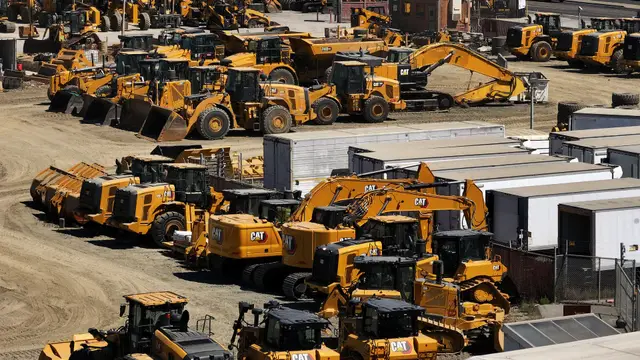
Brookfield and Blackstone, two of the world's largest alternative asset managers, are among the institutional investors moving in on what the industry calls "industrial outdoor storage."
Ownership of lots used to store industrial equipment is fragmented in markets across the U.S., which the Wall Street giants plan to capitalize on.
But real estate experts say local investors can still find opportunities to invest, especially in lots of three to five acres in size, and it is a market where rents have doubled since 2020.
In an aerial view, Caterpillar equipment sits parked in a lot at Peterson Cat, Aug. 5, 2025 in San Leandro, California.
Nondescript lots holding idle bulldozers, trucks and other industrial equipment are a common sight in local real estate markets across the U.S., and increasingly, a focus for Wall Street private investment giants.
If you haven't noticed them, it's probably because they so easily fade into the landscape, just another non-branded bit of land in the miasma of suburbia. But Brookfield and Blackstone, two of the world's largest alternative asset managers, are among the institutional investors moving in on what the industry calls industrial outdoor storage, or IOS. Investors are eyeing these lots as the AI build-out increases the demand for heavy equipment.
"We have strong conviction in industrial outdoor storage, which plays a critical role in our supply chain," said Devin Barnwell, a managing partner and co-leader of Brookfield's logistics business.
He says that up until now, the segment has been fragmented, but Brookfield sees that changing.
"We see significant opportunity to bring institutional capital and operating expertise to this fragmented sector, improving the quality and efficiency of these assets while strengthening the resilience of our industrial supply chains," Barnwell said.
Brookfield spent $1.2 billion earlier this year to take Peakstone Realty Trust private, a deal completed in May that gave it a portfolio of more than 70 industrial properties, most of them outdoor storage yards.
Blackstone is also ramping up in the sector, mainly as a lender. Its real estate debt arm has made six loans to outdoor storage owners totaling more than $1.1 billion, including a $244 million loan in June to Alterra IOS to buy 37 properties.
Despite the billions being bet on the market by Wall Street, there is still opportunity in the market for individual investors and local entrepreneurs looking to park their money where others park their equipment.
"1,000 percent yes," said Adam Petrillo, an executive managing director at Newmark, a commercial real estate advisory firm, who co-leads its industrial outdoor storage practice.
Petrillo said smaller, non-institutional investors, still control a significant amount of well-placed storage in secondary markets. "The good news for smaller investors and mom and pops is that a good individual IOS site isn't necessarily 50 acres," Petrillo said.
Lots as small as three to five acres in primary or secondary markets can still yield a robust return, he said. "At that bite size, an individual can step in. We are not talking about tens of millions ... a three-acre, well-located IOS with multiple use cases can be found, marketed, leased, and stabilized," he added.
Hottest outdoor storage property markets
The numbers help explain the appetite.
Rents for industrial outdoor storage roughly doubled across eight major markets between 2020 and the third quarter of this year, according to data from Newmark Research and Alterra IOS, an owner of such properties. Average rent per usable acre rose 103.5%, to nearly $11,000 a month, compared with a 66% increase for traditional industrial space, such as indoor warehouses.
Rent growth, according to Alterra, is most closely tied to infrastructure and energy activity in the area, even more so than data center development specifically.
The value of these properties can also increase if located near a seaport, rail line, or highway. But the gains weren't uniform. Baltimore (204%), Houston (159%) and Norfolk (148%) led, while South Florida and Savannah IOS actually trailed traditional industrial.
Lisa DeNight, managing director, head of North American industrial research at Newmark, said that Savannah's IOS vacancy remains quite tight despite the rent figures. Recent port activity is a potential factor, according to Alterra. Savannah's container volumes more than doubled between 2010 and 2022 but have since declined, while Houston saw roughly 15% growth from 2022 to 2025.
Petrillo said that there is still plenty of room left for values to increase, so an investor jumping in now hasn't missed the game. "We are still in the very early innings," Petrillo said.
Sam Cheema co-founder of CanTex Capital, a Dallas-based firm that acquires overlooked industrial real estate in Texas, is seeing increased demand for these lots.
"It comes down to supply and demand," he said. "If you need a warehouse you can usually find one. Properly zoned infill IOS sites are much harder to find and every year more of them are converted to warehouses and other uses," he said, referencing multifamily housing units. The scarcity makes tenants sticky. "So a limited supply keeps shrinking. And because so much of the value is in the land itself, owners keep the option to redevelop the site as the area grows," Cheema added.
Because of the imbalance of supply and demand, rents and prices are rising across the board, according to Cheema, but no two IOS properties look alike, which has kept the door open for smaller investors.
"Big institutions want exposure to IOS, but ownership is fragmented across mom-and-pop owners and small businesses, so it's hard to deploy large amounts of capital without first aggregating these assets into portfolios," Cheema said.
Unlike traditional warehouses, there's no standard spec like square footage or clear height to compare them. "That lack of standardization along with the ongoing growth of the asset class, means there's still runway for small investors to find opportunities," Cheema said.
"Financing has improved as more lenders have a better understanding of IOS, but it's still largely local and regional banks," Cheema added.
Zoning is the biggest challenge.
"If you don't understand the city's plans for the area, you may end up owning a use they're trying to phase out," Cheema said.
CanTex Capital works with the city and neighborhoods before buying to ensure the impact aligns with the community's plan for its future.
Advantages over traditional industrial, multifamily real estate
Alex Sutterer, an executive vice president at NAI Hiffman, a Chicago-area commercial real estate firm, said that beyond being a place to store big equipment, IOS attracts investors for two main reasons: lower capital expenditure requirements than traditional industrial or multifamily properties and the potential for higher yields.
"Capital improvements are also less specific to individual tenants, so owners can direct spending toward the property's overall functionality," Sutterer said.
For private investors, IOS typically trades at a yield around one percentage point higher than traditional industrial properties, helping attract smaller investors and family offices. "We believe that gap will continue to narrow as more institutional capital enters this space," Sutterer added.
Even for industrial properties with similar yields, he said the credit profile of tenants is generally stronger for IOS.
Shallow-bay, multitenant industrial properties — industrial facilities that tend to be much smaller than big-box distribution warehouses — have comparable yields. But unlike the local businesses that tend to fill up sh
San Francisco
Business
Saturday, November 14, 2026
6 min
By Katherine Langford

By Katherine Langford

By Marcus Chen

By Marcus Chen